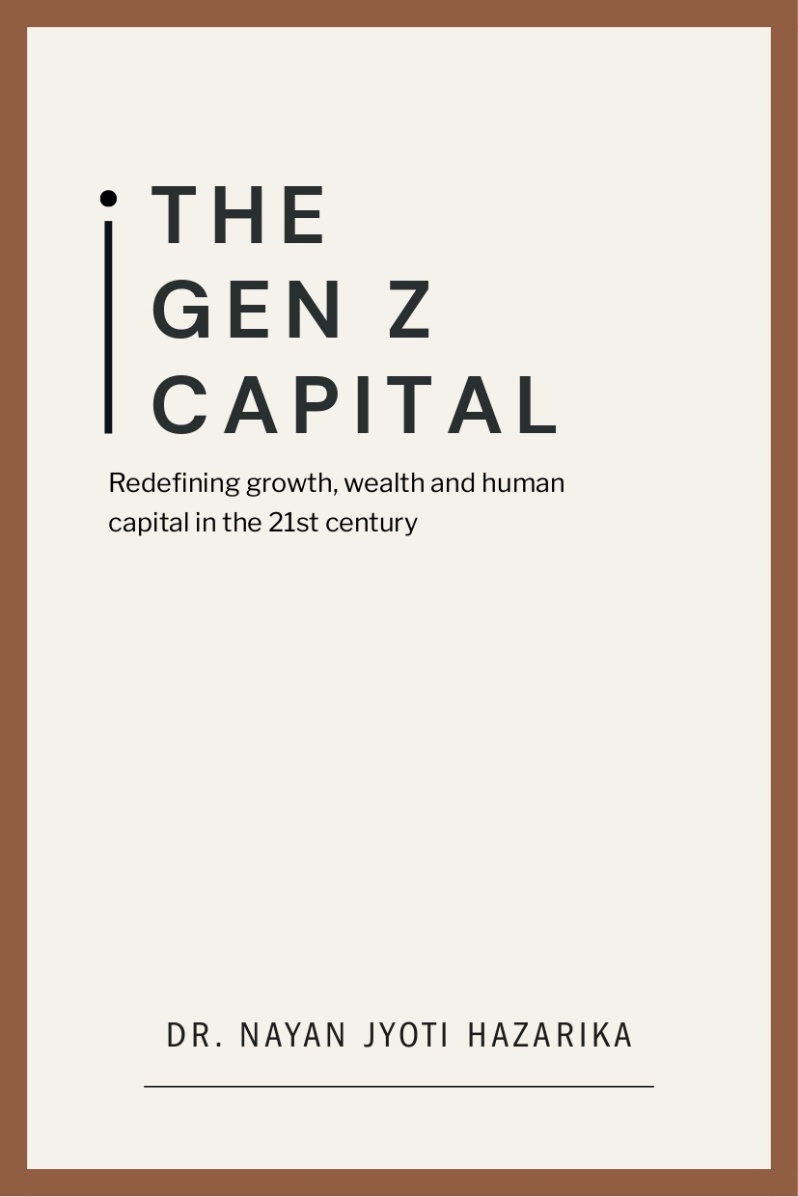
At a time when public discourse in India is often crowded by noise, slogans, and short attention spans, the arrival of a thoughtful book that dares to ask fundamental questions about the future of youth, economics, institutions, and national purpose deserves serious recognition. The Gen Z Capital, authored by Dr. Nayan Jyoti Hazarika, is one such rare contribution. It is more than a book, it is a framework, a manifesto, and a call to reimagine India through the aspirations of its youngest generation.
That this book emerges not from the familiar corridors of metropolitan power but from the culturally rich and intellectually vibrant North East of India is itself significant. For too long, national conversations have overlooked the region’s deep reservoir of thought leadership, social innovation, and civilizational confidence. With this work, Dr. Hazarika reminds the country that the North East is not merely a frontier of geography, it is also a frontier of ideas.
The author, hailing from Assam, brings to the national table a perspective shaped by lived realities often absent in mainstream policymaking: community resilience, ecological sensitivity, youth aspiration, cultural rootedness, and the desire for dignified development. In an age where India seeks balanced growth, voices from the North East are no longer optional, they are essential.
What makes The Gen Z Capital compelling is its bold central proposition: that Generation Z must not be seen merely as consumers, job seekers, or social media users, but as nation-builders. In many ways, this generation has inherited the contradictions of the modern world, technological abundance but emotional anxiety, economic expansion but inequality, global connectivity but social fragmentation. Dr. Hazarika argues that Gen Z also possesses the moral imagination and entrepreneurial energy to solve these contradictions if given the right institutional environment.
This is where the book rises above generic youth commentary. Rather than offering clichés about startups and digital India, it presents a structured ideological roadmap. It explores ideas such as ethical growth, decentralised opportunity, digital sovereignty, education as empowerment, and institutions that serve human dignity rather than bureaucracy. It seeks to replace passive dependency with productive citizenship.
Dr. Hazarika’s work is particularly notable because it comes from a young right-of-centre intellectual tradition that is increasingly shaping India’s public life. While much of the right wing in India has been associated with political mobilisation, cultural revival, or governance narratives, The Gen Z Capital attempts something more ambitious: it gives ideological direction to youth policy in the 21st century.
This is an important development. Nations progress not only through elections and schemes, but through ideas that inspire generations. The author belongs to a growing school of nationalist thinkers who believe that India’s rise must be both modern and civilizational, both innovative and rooted. In that sense, the book can be seen as a bridge between contemporary youth concerns and broader Indian philosophical traditions of collective welfare, duty, and balanced progress.
The concept of “Integral Capitalism,” explored in the text, is one such example. Rather than importing purely Western binaries of capitalism versus socialism, the author proposes an indigenous middle path, an economy where markets operate, entrepreneurship thrives, but human welfare remains central. It is a timely intervention at a moment when many young Indians seek prosperity without losing ethical purpose.
Another strength of the book is its clear recognition that GDP alone cannot define progress. In an era where mental health, climate anxiety, loneliness, and cultural dislocation are rising among youth globally, Dr. Hazarika asks whether success should also be measured by meaning, resilience, and community well-being. This places the work in conversation with some of the most advanced global debates on development.
The author is equally sharp in examining technology. He acknowledges that Gen Z is born digital, yet warns against becoming digitally colonised by addictive platforms, surveillance systems, and shallow attention economies. His call for “tech as tool, not master” is perhaps one of the most relevant messages for today’s youth. It urges young Indians to become creators, coders, builders, and sovereign users not passive data subjects.
Education, too, receives serious treatment. The book rejects the outdated idea that education is merely a conveyor belt to employment. Instead, it sees learning as empowerment meant to cultivate creativity, emotional intelligence, civic spirit, and self-belief. For a nation with the world’s largest youth population, this argument carries immense policy relevance.
Perhaps the most striking contribution of The Gen Z Capital is its confidence in youth leadership. Many older frameworks speak about youth. This book speaks to youth and importantly, with youth. It does not portray them as helpless victims of circumstance, but as active participants in shaping institutions, businesses, and communities.
This optimism is refreshing. Too often, public debate oscillates between romanticising young people or blaming them. Dr. Hazarika chooses a more responsible path: empowering them.
The author himself embodies this synthesis of scholarship and activism. A researcher, thinker, and public-minded intellectual from Assam, he represents a new generation emerging from beyond India’s conventional centres of influence. His rise is symbolic of a larger democratic shift in Indian thought where ideas can now emerge from Guwahati, Jorhat, Imphal, Shillong, or Itanagar as confidently as from Delhi or Mumbai.
That matters deeply for national integration. Intellectual federalism is as important as political federalism.
In praising the book, one must also praise the courage behind it. Writing a serious ideological work for youth in an age dominated by reels and reactions is no easy task. It requires discipline, conviction, and belief that ideas still matter. Dr. Hazarika has shown all three.
India stands at a demographic crossroads. Its youth bulge can become a dividend or a disruption. The difference will depend on whether the country can offer not only jobs, but purpose; not only growth, but fairness; not only connectivity, but character.
The Gen Z Capital enters this conversation at precisely the right time.
It deserves to be read by policymakers, educators, entrepreneurs, students, and all those concerned with India’s next chapter. More importantly, it deserves to spark a broader movement: one where Gen Z does not wait for the future but leads it.
And in giving that generation a roadmap, Dr. Nayan Jyoti Hazarika has done something notable: he has ensured that the North East speaks not from the margins, but from the centre of India’s future.
Published by Wissenmonk.
https://amzn.in/d/00VA9DGI